-
Speaker
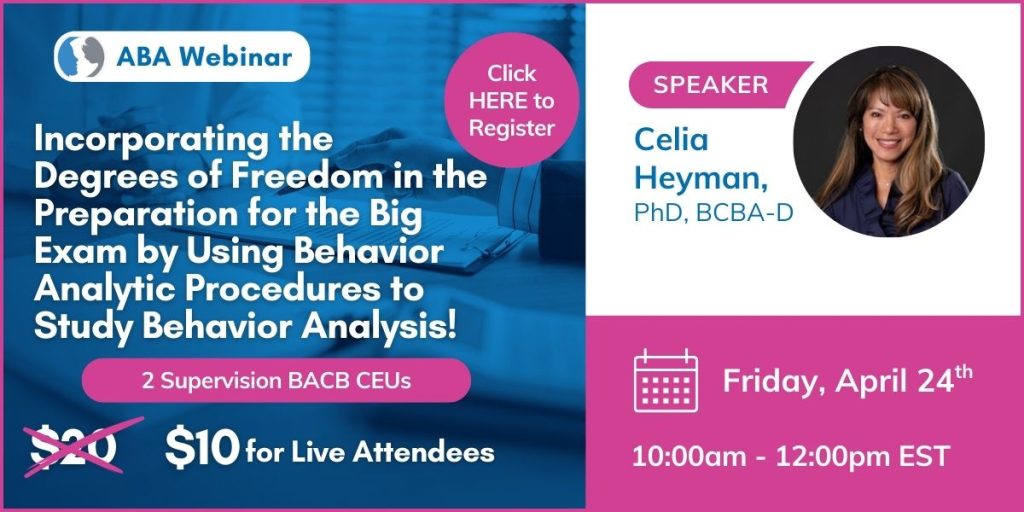
Celia Heyman, PhD, BCBA-D
-
Date
Friday, April 24, 2026
-
Time
10:00 am - 12:00 pm
-
Location
Via Behavior Live
Are you responsible for helping supervisees or staff prepare for the high-stakes Applied Behavior Analysis (ABA) credentialing exam? Do you incorporate assent in preparing your supervises or staff for the big exam? Earning the BCBA® credential requires passing a rigorous examination based on content outlined by the Behavior Analyst Certification Board (Dubuque & Kazemi, 2022). Researchers have examined the relationship between first-time pass rates and the quality of university training programs (Critchfield, 2015; Dubuque & Kazemi, 2022; Guinness & Atkinson, 2024). However, relying on a single quality indicator provides a limited view and does not capture the complex variables and contingencies inherent in all training programs. Accessibility to training is also a significant factor, as students entering ABA programs come from varied backgrounds. Factors such as available resources, the ability to relocate for on-campus instruction, workload, and family or cultural responsibilities all influence access and success within these programs. Many aspiring behavior analysts may exit their university training programs without having completed their supervision requirements. Without continued access to university resources—such as faculty support, peer collaboration, and academic materials—these individuals often rely on workplace supervisors to continue developing their understanding and application of behavioral principles. Quality supervision may be a critical factor in helping aspiring behavior analysts pass the certification exam (McNeely, 2025). Supervision experience is likely a critical factor in passing the BCBA® exam, which emphasizes the application of knowledge through scenario-based questions. Supervised fieldwork offers supervisees the opportunity to practice and apply concepts from the BACB Task List, effectively bridging the gap between theoretical understanding and real-world implementation. Since the exam assesses fluency of knowledge (Johnston et al., 2014), high-quality supervision ensures structured and comprehensive exposure to essential content, reinforcing key skill repertoires. Interestingly, although behavior analysts regularly use evidence-based teaching strategies to promote learning in clients, many exam candidates do not apply these same behavior analytic principles to their own study practices. This talk will describe the differences between the concepts of compulsory, consent, assent, and how the degrees of freedom is reflected in your process of preparing your supervisees/staff for the credentialing exam. This workshop will discuss the behavior analytic teaching methods for studying behavior analysis, along with practical test-taking strategies to support preparation for the BCBA® examination.
Learning Objectives
- Attendees will be able to discriminate consent vs assent and describe the degrees of freedom.
- Attendees will demonstrate an understanding of the current landscape and outcomes associated with the BCBA® credentialing exam.
- Attendees will apply Bloom’s Taxonomy to the study of behavior analytic content to support effective learning.